Rainwater should not collect beside your home’s foundation. When a downspout releases roof runoff too close to the house, the soil can become wet, muddy, and eroded.
A gutter drain extension helps move that water farther away from the foundation. It can be a simple surface pipe, an underground drainage line, a pop-up emitter, or another drainage option.
For homeowners in Traverse City and Northern Michigan, the right setup matters. Heavy rain, spring snowmelt, and freeze-thaw cycles can add water around the home.
H2O Drainage Systems is a locally owned drainage and waterproofing company based in Interlochen, MI, serving Traverse City and the surrounding region since 2024. This guide walks through how gutter drain extensions work, when they’re enough on their own, and when a property needs something more. If you already know you need one installed, you can go straight to our gutter extension services page to request a free estimate.
What Is a Gutter Drain Extension?
A gutter drain extension connects to the bottom of a downspout and carries rainwater away from the house. It is also commonly called a downspout extension.
The basic path is simple:
Roof → Gutter → Downspout → Extension → Safe Discharge Area
Without an extension, water may leave the downspout right beside the foundation. A properly planned extension moves the discharge point to an area where the water can drain safely.
The right system depends on:
- Yard slope
- Soil conditions
- Roof runoff
- Landscaping
- Available space
- Foundation type
- Where the water can safely go
The goal is not just to make the pipe longer. The goal is to move water away from the house without creating another drainage problem.
Why Does a Downspout Extension Matter?
Your roof can collect a large amount of rainwater during a storm. Gutters collect that water and downspouts carry it to the ground.
If the downspout ends next to the foundation, much of that water can soak into the soil beside the house.
Building Science Education recommends directing downspout water away from the foundation. Keep it over 5 feet away, or over 10 feet for underground systems.
A good extension can help:
- Reduce standing water
- Limit soil erosion
- Keep water away from the foundation
- Reduce moisture around basements and crawl spaces
- Protect landscaping near the downspout
However, an extension cannot fix every drainage problem. If the yard slopes toward the home or water has nowhere safe to go, a larger drainage solution may be needed — more on that below.
Why Gutter Drain Extensions Matter in Northern Michigan
Northern Michigan homes face heavy rain, spring snowmelt, and changing ground conditions.
Spring can be especially important. Snow melts and adds water to the roof and gutter system. In the sandy soil common across Grand Traverse, Leelanau, and Benzie counties, that runoff can travel down toward the foundation quickly if it isn’t redirected. If the downspouts discharge close to the house, a large amount of water can collect around the foundation in a short window.
Freeze-thaw cycles can also affect drainage. Surface extensions may move when the ground changes, while poorly planned underground lines can hold water or become difficult to maintain.
This is why the drainage route matters as much as the extension itself.
A downspout should send water to an area where it can continue moving away from the home. See our full service area to check if we cover your community.
Signs You Need a Gutter Drain Extension
You may need a longer or new extension if you notice:
- Water pooling near the foundation
- Mud below a downspout
- Soil washing away after rain
- Mulch moving away from the house
- Water collecting near a basement door
- Moisture near a crawl space
- A downspout ending right beside the foundation
- An old extension that is broken or too short
You may also notice a small trench forming below the downspout. This often happens when the same stream of water hits the soil during repeated storms.
If the problem keeps returning, just adding a longer pipe might not help. You may need a professional to check the yard grading and drainage route. Our gutter extension services page covers what a professional evaluation looks like.
Types of Gutter Drain Extensions
Different properties need different drainage options.
The most common choices include:
- Surface downspout extensions
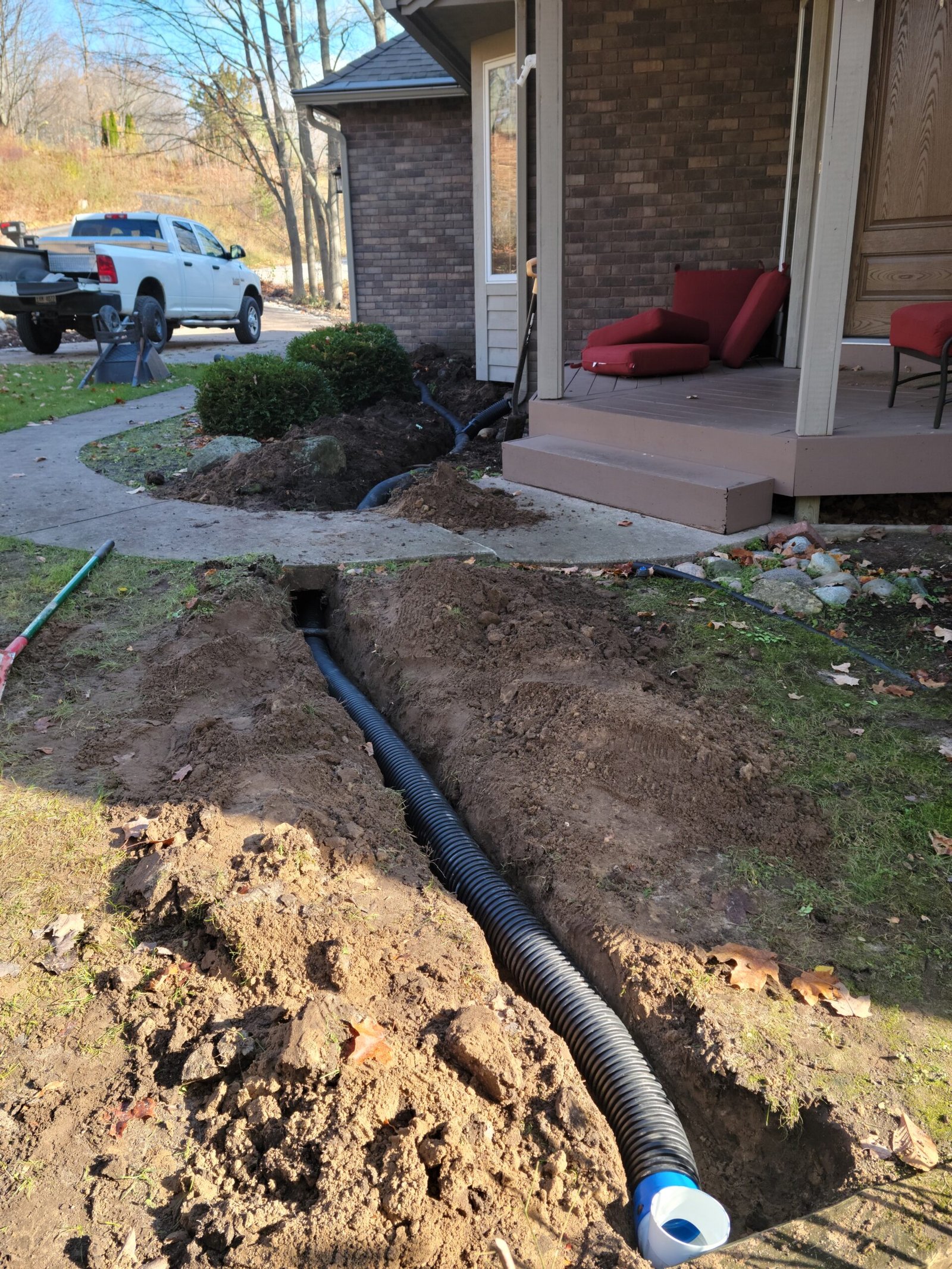
- Underground downspout extensions
- Pop-up emitters
- Splash blocks
Extensions also come in a few different materials, and the right one depends on the setting:
- Aluminum: Durable and low-maintenance, a common choice for permanent surface extensions.
- Flexible or corrugated: Easy to route around obstacles like garden beds or downspouts that need a curved path, though they’re less discreet.
- PVC: The standard choice for underground lines, since it holds up to buried, wet conditions.
- Decorative: Rock-look or themed covers that hide the extension while still directing water where it needs to go.
Surface Downspout Extension
A surface extension carries water across the ground and away from the house.
It can work well when:
- The yard has enough open space
- The ground slopes away from the house
- The pipe will not create a trip hazard
- The discharge area can handle the runoff
Surface extensions are simple to inspect and maintain. You can also see where the water is going. The main drawback is appearance. The pipe remains visible and may get in the way of mowing or landscaping.
For a simple drainage problem, however, a surface extension may be all you need.
Underground Downspout Extension
An underground extension carries water through a buried pipe. This can be a good option when you want to keep the yard clear or need to move water farther away from the foundation. A buried system needs proper planning. The pipe needs a suitable route and enough slope for water to move toward the outlet.
The discharge point is also important. A buried pipe that simply releases water into another low area may only move the problem to a different location.
For below-ground drainage, EPA guidance recommends suitable piping and directing water to an appropriate discharge area.
Pop-Up Emitter
A pop-up emitter is placed at the end of an underground drainage pipe. When water reaches the outlet, the emitter opens and allows the water to flow onto the surface. When the water stops, it closes again.
A pop-up emitter can keep the discharge point less noticeable and help maintain a cleaner-looking yard. But the emitter is only the outlet. The underground pipe still needs a good route, proper slope, and enough capacity for the water.
Splash Block
A splash block sits at the bottom of a downspout and helps direct water away from the foundation. It can reduce soil erosion near the discharge point.
However, a splash block usually does not move water very far. If water needs to travel several feet away from the house, a downspout extension may be a better choice.
Surface vs. Underground Drainage
| Feature | Surface Extension | Underground Drain |
| Cost | Usually lower | Usually higher |
| Installation | Simpler | More involved |
| Appearance | Visible | Mostly hidden |
| Maintenance | Easy to access | May need planned access |
| Best for | Simple drainage needs | Longer or cleaner drainage routes |
Neither option is right for every property. The best choice depends on the amount of water, yard layout, soil, slope, and available discharge area.
How Far Should a Downspout Extension Go?
Distance isn’t everything, but it’s a good starting point. Most extensions move water about 4 to 10 feet from the foundation, depending on the setup.
DOE Building Science suggests directing downspout water to a slope at least 5 feet away from the foundation. For underground catchment systems, it recommends a location more than 10 feet from the foundation. Homes with poor grading, slow-draining soil, or heavy runoff often land toward the longer end of that range.
An extension that ends the “right” number of feet away can still cause problems if the ground slopes back toward the house. The discharge area is more important than the tape-measure distance. It must let water flow away from the foundation, not just meet a minimum length.
How to Install a Gutter Drain Extension
A good installation starts by looking at where the water needs to go.
1. Check the Downspout
Look for:
- Cracks
- Loose connections
- Blockages
- Damaged elbows
- Water leaking at the joints
The existing gutter and downspout should be working properly before adding an extension.
2. Find a Safe Discharge Area
Choose an area where water can drain without flowing toward:
- The foundation
- Basement entrances
- Walkways
- Neighboring properties
- Another low spot
The outlet should have enough space to handle the runoff. If the natural discharge path crosses a driveway or walkway, use a recessed channel drain. This drains water underneath the surface. It helps avoid trip hazards and icy patches in winter.
3. Check the Yard Slope
Look at how the ground falls around the house. If the yard slopes toward the foundation, a longer surface extension may not solve the problem.
The water needs a route that continues away from the home. As a general target, aim for at least a ¼-inch drop per foot of extension (roughly 1 inch of fall for every 10 feet of pipe) so water keeps moving by gravity instead of pooling partway along the route.
4. Choose the Right Extension
Depending on the property, you may need:
- Surface pipe
- Underground drainage pipe
- Pop-up emitter
- Splash block
- Another drainage solution
5. Test the Drainage
Run water through the downspout and watch where it goes.
Check for:
- Pooling
- Backflow
- Erosion
- Water flowing toward the house
For an underground system, testing before the trench is fully restored can help identify problems early.
Common Downspout Drainage Problems
A new extension can still fail if the drainage route is poorly planned.
Extension Is Too Short
The water may still be discharged too close to the foundation.
Ground Slopes Toward the House
The water can travel back toward the foundation even after it leaves the extension.
Pipe Has Poor Slope
Water can collect inside an underground line when the pipe does not drain properly.
Outlet Is Blocked
Leaves, soil, mulch, or other debris can restrict the discharge point.
Underground Pipe Is Damaged
A crushed or separated pipe can allow water to escape before it reaches the intended outlet.
Water Is Sent to Another Low Spot
Moving water away from the downspout does not help if it simply creates standing water somewhere else.
The System Freezes
In Northern Michigan, freezing conditions can affect drainage routes and outlets. The system should be planned with local weather and site conditions in mind.
Can a Gutter Drain Extension Prevent Basement Leaks?
A downspout extension can help when roof runoff is contributing to moisture around the foundation. Concentrated roof runoff is one of the more common contributors to seasonal basement seepage in porous, sandy soil like much of what’s found around Grand Traverse Bay.
But it cannot fix every basement leak.
Basement moisture can also come from:
- Poor grading
- Groundwater
- Foundation cracks
- Wall or floor openings
- Exterior drainage problems
- Interior drainage problems
- Sump pump issues
If water continues to enter the basement after the downspouts have been improved, the home may need a broader drainage evaluation.
When a Gutter Extension Alone Isn’t Enough
A downspout drainage system helps manage rainwater from the roof and move it away from the home. However, it cannot solve every type of water problem. In some cases, continued moisture around the home may be caused by poor grading, groundwater, foundation issues, or another drainage system.
Depending on the problem, you may need:
- Interior waterproofing for moisture entering through foundation walls or floor joints
- Interior drainage systems to collect and redirect water
- Exterior drainage systems to manage water outside the home
- Crawl space drainage to help control moisture below the home
- Sump pump installation for properties that need active water removal
Learn more about our approach on our About page, or see the materials we use across these systems. You can also view our service areas to see the communities we serve, including Traverse City, Acme, Interlochen, Elk Rapids, and surrounding areas.
DIY vs. Professional Downspout Extension Installation
A basic surface extension can be a manageable project for some homeowners.
DIY installation may make sense when the drainage problem is simple and the yard already has a good slope. A basic above-ground extension and a splash block are usually the easiest starting point for a DIY fix.
Professional help may be a better choice when:
- You need an underground drainage system
- Water keeps pooling
- The yard slopes toward the home
- Several downspouts need to be connected
- The basement or crawl space has moisture
- You are unsure where the water should discharge
The biggest mistake is focusing only on the extension length. The real question is: where will the water go after it leaves the downspout? If there’s no clear answer, the property might need more than a basic extension. That’s when you should get a professional evaluation.
Why Northern Michigan Homeowners Work With H2O Drainage Systems
We’re a local-owned drainage company based in Interlochen, MI. Since 2024, we’ve provided long-term drainage and waterproofing solutions for homes in Traverse City and Northern Michigan. We focus on lasting results, not quick fixes.
When we evaluate a gutter or downspout drainage issue, we look at the whole picture, not just the pipe:
- Evaluate the existing drainage — downspouts, grading, discharge areas, and any signs of water buildup.
- Recommend the right solution — a surface extension, buried pipe, pop-up emitter, or a different approach, based on the amount of water, yard layout, soil, and slope.
- Install and test — we install with proper connections and a suitable route, then run water through the system to confirm it reaches the intended discharge area.
This approach helps prevent a common problem: moving water away from one location only to create a new one somewhere else in the yard.
Homeowners say our team is direct and detailed. We focus on finding the real cause of drainage or basement issues. We don’t rush to the most expensive solution. You can see more of that feedback and our completed work on the project gallery.
Protect Your Foundation With Better Downspout Drainage
A downspout drainage solution is a small part of your home’s overall drainage system, but it can help prevent water from collecting next to the foundation.
The right solution depends on your home’s layout, yard slope, soil, and where the water can safely drain.
If you are seeing erosion, standing water, or basement moisture near a downspout, the problem may need more than a basic extension. Ready for a professional opinion? Visit our gutter extension services page to request a free on-site estimate, or contact us directly.
Call 231-392-6350 to discuss your drainage needs, or reach us at hello@h2odrainagesystems.pro.
FAQ
What is a gutter runoff extension used for?
A downspout drain extension carries rainwater from a downspout farther away from the foundation. This can help reduce soil erosion, standing water, and excess moisture around the home.
How long does a downspout extension need to be?
It depends more on where the water ends up than on a fixed number. A shorter extension can be effective if it drains onto sloped ground away from the house. But a longer one might not work if it empties into a low area that drains back toward the foundation. Our gutter extension services page covers typical distance ranges for this region.
Can a downspout drainage system prevent basement leaks?
A downspout drainage extension can help when roof runoff is contributing to basement moisture or leaks. However, it cannot fix every cause of basement leaks. If moisture continues after redirecting the downspouts, waterproofing or another drainage solution may be needed.
Should I bury my downspout drainage?
An underground system can be a good option when you need to move water farther away from the home or want to keep the yard clear. Surface extensions may work well for simpler drainage situations.
Can I install a downspout extension myself?
A basic surface extension is often a manageable DIY project if your yard already slopes away from the house and the drainage need is simple. Underground systems, persistent pooling, or sloped yards that direct water back toward the foundation usually call for a professional evaluation to get the route and grade right.